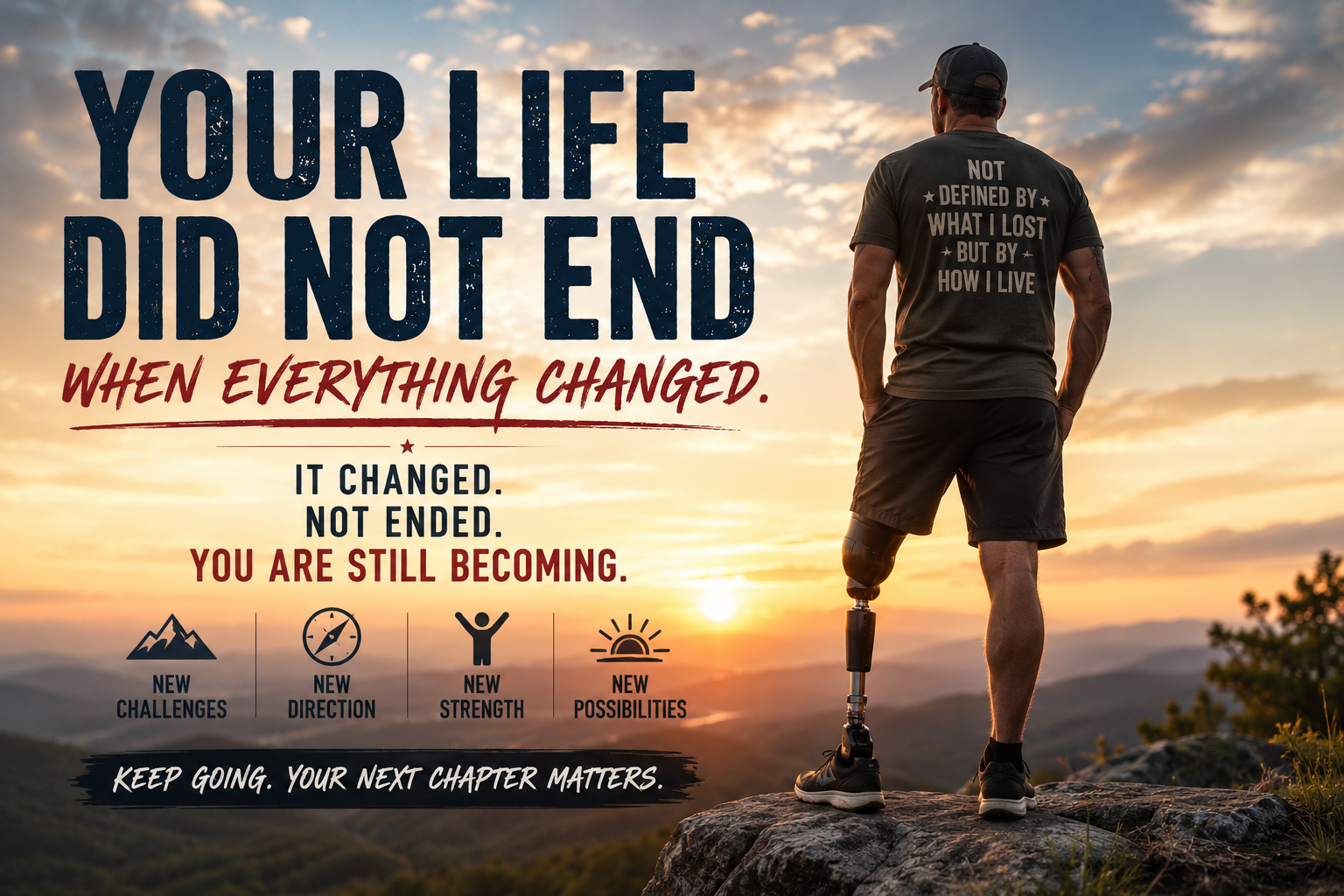
Your Life Did Not End When Everything Changed
There is a moment after limb loss when the world can feel divided into two parts: the life you had before, and whatever comes next.
Before, you may have moved without thinking about it. You got out of bed, walked across a room, climbed into a truck, went to work, took a shower, carried groceries, played with your kids, or stood in line at the store without giving any of it much thought. Then something happened. An accident. An illness. An infection. A circulation problem. Cancer. A military injury. A surgery that could not be avoided.
And suddenly, ordinary things were no longer ordinary.
The world did not stop. Bills still arrived. People still expected answers. The dog still needed to go outside. Somebody still needed dinner. Your friends kept talking about their problems. Traffic still backed up at five o'clock. Life continued moving even while yours seemed to have slammed into a wall.
That can be one of the hardest parts of becoming an amputee.
Everything changes, but not everything waits for you to catch up.
You may have heard people tell you that you are strong. Maybe you are. You may have been told that you are inspiring. Maybe you would rather just be allowed to have a bad day without becoming somebody else's motivational story.
There is nothing wrong with that.
Limb loss does not automatically turn a person into a superhero. It does not erase anger, frustration, embarrassment, grief, exhaustion, fear, or the occasional desire to throw a prosthetic device through the nearest window.
It changes your body.
It changes some of the ways you do things.
It may change how you see yourself.
But it does not cancel your life.
The First Victory May Be Smaller Than You Expected
Recovery often gets described in dramatic terms. Walking again. Returning to work. Driving. Traveling. Competing in sports.
Those things matter.
But some of the most important victories happen long before anyone takes a photograph of them.
The first time you transfer safely without help.
The first shower that does not feel like a dangerous expedition.
The first time you put on your prosthesis without needing somebody beside you.
The first trip into a grocery store.
The first time you fall and realize you can get back up.
The first time you laugh about something that would have made you furious a month earlier.
These moments rarely make headlines, but they matter because they represent something much larger.
They are pieces of your independence coming back.
Progress after amputation is not always dramatic, and it is rarely a straight line. One day you may feel like you are finally getting somewhere. The next day your residual limb hurts, the socket feels wrong, your energy disappears, and tying your shoes feels like an unreasonable demand from civilization.
That does not erase the progress you already made.
Your Prosthesis Is a Tool, Not Your Identity
For some amputees, a prosthesis becomes an essential part of daily life. For others, it is useful only in certain situations. Some people walk extremely well with one. Others use crutches, wheelchairs, adaptive equipment, or different combinations depending on the day.
There is no prize for using a prosthesis longer than somebody else.
There is no failure in taking it off.
There is no requirement that your body perform according to somebody else's expectations.
A prosthetic limb can be an extraordinary piece of technology, but it is still a tool. It does not define the person wearing it.
Neither does a wheelchair.
Neither does a scar.
Neither does the absence of a limb.
You are still the person who had opinions, skills, bad habits, ambitions, responsibilities, relationships, hobbies, and plans before all of this happened.
Some of those things may change.
Many will not.
And new ones may appear that you never expected.
Independence Does Not Mean Doing Everything Alone
One of the strange lessons of limb loss is that independence sometimes requires accepting help.
That can be difficult.
People who spent their lives fixing their own problems often struggle when somebody else has to carry something, drive somewhere, open a stubborn door, or help with a task that used to be effortless.
Accepting help does not mean surrendering independence.
The real goal is having control over your own life.
Sometimes that means doing something yourself.
Sometimes it means using adaptive equipment.
Sometimes it means asking somebody for assistance because spending forty-five minutes proving you can do something alone is not always the best use of your afternoon.
You also have the right to say no.
People may try to help when you do not need it. Strangers may grab your wheelchair. Someone may reach for your arm while you are balancing. Family members may start doing things for you before you have even had the opportunity to try.
A simple "I've got it" is enough.
Your body changed. Your right to make decisions about it did not.
There Will Be Bad Days
Some days are going to be difficult.
Your prosthesis may hurt.
Phantom sensations may keep you awake.
Insurance paperwork may make absolutely no sense.
A perfectly accessible building may somehow have its accessible entrance behind a dumpster, around a corner, and through a door nobody remembered to unlock.
Someone may stare.
Someone may ask a ridiculous question.
Someone may tell you about their uncle's neighbor's cousin who lost a leg and now climbs mountains every weekend.
You are allowed to be irritated.
You are allowed to grieve what you lost.
You are allowed to miss the body you had.
None of those feelings mean you have given up.
Grief and forward movement can exist at the same time.
Your Story Is Still Being Written
The most important thing to remember after limb loss is not that everything will return to normal.
It may not.
Some things will become harder. Some will become easier with time. Some will require equipment, planning, patience, or a completely different approach.
There may be parts of your old life that you cannot recover exactly as they were.
But there is an enormous difference between saying, "My life changed," and saying, "My life ended."
It did not end.
You are still here.
There are still places you have not been. People you have not met. Work you have not done. Arguments you have not won. Bad jokes you have not told. Meals you have not enjoyed. Mornings you have not seen.
You do not have to become an inspiration.
You do not have to prove anything to strangers.
You do not have to pretend that losing a limb was somehow a gift.
You only have to keep building a life that belongs to you.
It may look different now.
Different is not the same thing as finished.